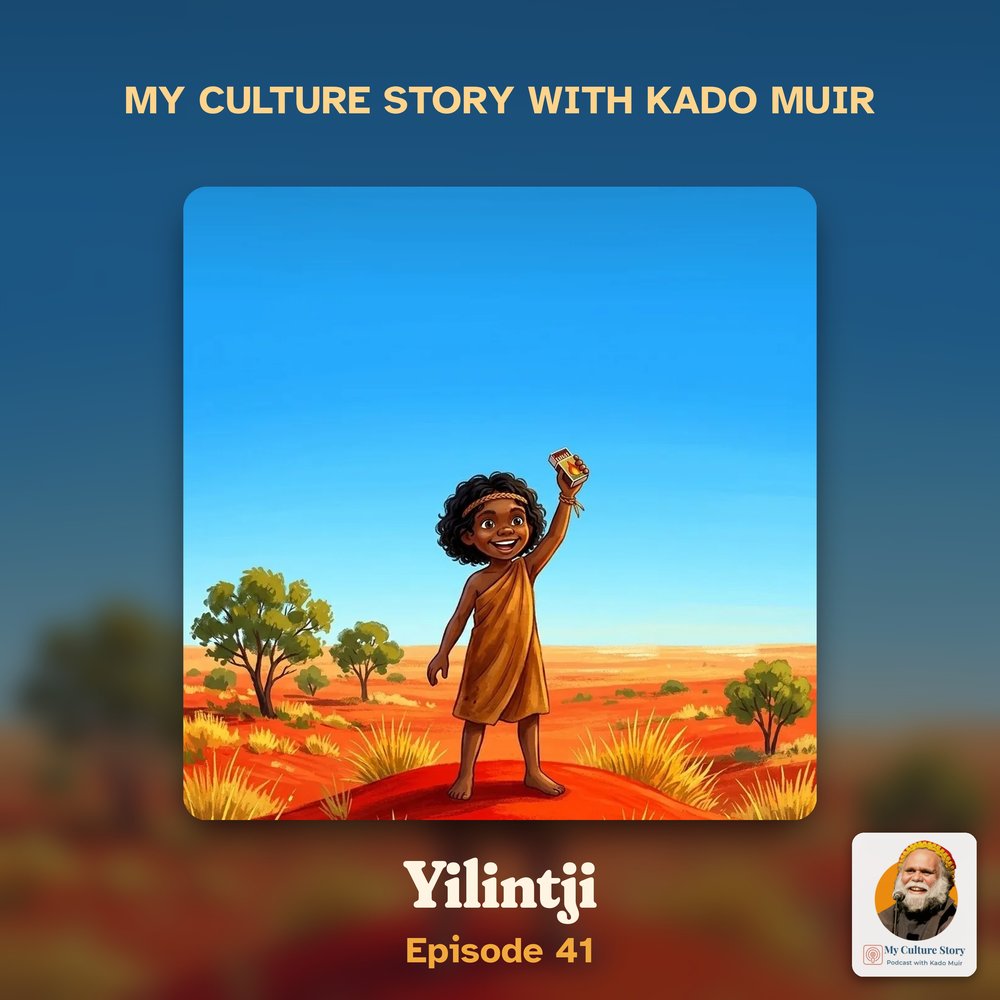
Yilintji: The Little Girl and the Matches
In this episode, Kado Muir shares his children's story Yilintji, about a brave Ngalia girl, some very strange 'monsters' and a little box of matches. Kado talks about where the story comes from, four words from language, and questions for families to talk about together.
Chapters
- Welcome
- Where this story comes from
- Reading the story
- The culture and language in the story
- Questions for families
- Close
Transcript
Made from the recording. Tap a time to listen from there.
Wutayi pirni = hello everyone.
Welcome to My Culture Story with Kado Muir.
This is episode 41.
My name's Kado Muir.
I'm a Ngalia man from Leonora, in Western Australia.
Tonight I record this podcast sitting in a room at the Agnew Gold Mine camp, on Agnew Lawlers
country.
I grew up living with my parents and two brothers around Agnew.
We camped in the bush not far from where I am sitting tonight.
Before we start, I want to acknowledge Country.
country I acknowledge the Ngalia people, and the Traditional Owners of the lands you're listening on today.
I pay my respects to Elders, past and present.
And I pay my respects to the young ones coming up.
Today's story is called Yilintji.
It's a children's book that I wrote.
It's about a big sandhill.
It's about some very strange animals.
And it's about a brave little girl.
Yilintji is a word from our language.
By the end of the story, you'll know what it means.
So get comfy.
Call the kids over.
Let's go.
I first told this story way back in Episode 9.
That was January 2020.
Now it's a book, and I'm glad to share it again.
So, where does it come from from?
My mother told it to me.
I was a young boy then, living in the bush.
I have these wonderful memories of sitting around the campfire, some of the more vivid ones are in
the heart of winter.
On those cold wintery nights, my brothers and I would gather at our others feet, warming ourselves by
the campfire and she would tell us stories from the dreaming, from the old people, our tjukurrpa or
dreaming stories, but also our kutjilpitu, the stories of the old times.
We would drift warm and cosy by the fire snuggled at our mothers feet and what would leave
its mark on my memory is watching the frost settle on the land, as dead tree branches would
turn icy white in the moonlight.
Those were wonderful times and i am so privaleged to have been told these unwritten stories from so
long ago, which I can now share with you today.
That's how stories travel in our families.
They go from the old people to the children.
From one campfire to the next.
This one is about how our old people first saw camels.
And white explorers.
And matches.
It's also about why they thought the camels were mamu.
Mamu means monster.
You'll hear that word alo's the story.
Yilintji.
Long ago, before Leonora was a town, Ngalia people lived in the spinifex country, north of Laverton. Families travelled across Country, living according to the knowledge passed down by their old people.
One day, a group of children were playing on a big sandhill. They climbed to the top, slid down the sandy slopes, laughed and chased each other.
It was a beautiful day, and everyone was having fun.
Suddenly, one of the children stopped playing.
Far away, something enormous was coming over the sandhill.
It had a long neck, a strange head and a huge body.
Nobody had ever seen anything like it.
"Mamu! Mamu!" the children shouted.
"A monster is coming!"
They jumped up and scattered in every direction, running as fast as their legs could carry them.
The children called out to their families.
The old people grabbed their spears and belongings.
Everyone began running away from the frightening creatures.
And then another Mamu appeared.
And another!
There were three or four of them!
But one little girl couldn't run fast enough.
One of the strange creatures came towards her.
Before she could escape, she was caught.
The others watched in horror from a distant sandhill.
"Oh, nyarru! That poor little girl!"
The families stood together on a distant sandhill, watching.
They were frightened and terribly sad.
They thought the Mamu might eat the little girl.
But then something extraordinary happened.
"Look!" someone cried.
"The Mamu is coming apart!"
The great long-necked creature seemed to split into two.
One part was still a huge animal.
The other part looked like a person!
The people watched in amazement.
The strange person began pulling things off the enormous animal.
It looked as though the Mamu was tearing the skin off another Mamu!
"What are they doing?" the old people wondered.
The strangers began gathering wood.
More and more wood.
They made a great big pile.
The old people grew even more frightened.
They thought the strangers were preparing to cook something enormous.
Perhaps the little girl!
The families were too frightened to stay.
"We cannot stay here," they said.
They turned and continued their journey.
The little girl was left sitting with the strangers.
But she was watching everything very carefully.
The little girl looked closely at the strangers.
They were not monsters.
They were men!
Their skin was a different colour, and they wore strange clothes.
The enormous animals were something she had never seen before.
The men gathered around their pile of wood.
One of them took out a little box.
He pulled out a small stick.
Scratch!
Suddenly, a flame appeared!
The little girl stared in amazement.
How could someone make fire with a tiny stick?
The men mixed some white stuff together.
They put it into the fire and cooked it.
Then they broke pieces off and began eating.
The little girl watched carefully.
They were making food, not cooking her!
The men were busy eating.
Nobody was watching the little girl.
She looked at the small box that had made the magical fire.
She had never seen anything like it.
This was something worth taking home.
Quick as a flash, she grabbed the box of matches!
Then she jumped up and ran.
Across the sandy ground.
Over the sandhills.
Away from the strange men and their enormous animals.
The little girl followed her family's tracks until she caught up with them.
Everyone was astonished.
"You're alive!"
"We thought the Mamu had eaten you!"
The old people were overjoyed to see her.
The little girl told everyone what she had seen.
The Mamu were not really monsters.
They were strange animals carrying men on their backs.
The men wore clothes and carried things the people had never seen.
And she had brought something wonderful back with her.
She showed the old people the little box.
Inside were tiny sticks that could make fire.
They were matches.
Yilintji!
The old people kept the matches.
It was the first time they had ever seen such a thing.
The enormous Mamu were actually camels.
The strange men were explorers travelling across the desert.
When the people thought the Mamu were coming apart, the men were simply climbing down from their camels.
When they thought the men were pulling the animals' skin off, they were removing their saddles.
Many years later, the little girl's story was told to another generation.
And another.
The story travelled from the old people to the children, from one campfire to the next.
Eventually, Kado's mother told him the story when he was a young boy living in the bush.
This is how our old people first came to know about camels, white explorers and Yilintji matches.
It is a story about fear, curiosity, discovery and a brave little girl who brought something new home to her people.
And because our old people kept telling their stories, we can still share them today.
Palunya.
Palunya.
That's it.
Now, let me tell you a bit about what's in that story.
First, Country.
This story starts in the spinifex country, north of Laverton.
Our families the families travelled across Country, and they lived by what the old people taught them.
Country was home.
And it was also where you learned.
and Meanwhile, the children were doing what kids everywhere love to do.
They were a up on a sandhill, sliding down and laughing.
Second, family.
When the children shouted, the families came running.
The old people got everyone moving.
And when they thought the little girl was lost, they were so sad.
They said, 'Oh, nyarru!' Nyarru means poor thing.
It shows how much they cared for her.
And when she came back, oh, they were happy.
Third, something brand new.
These people had never seen a camel.
Or a saddle.
Or an explorer.
So they used what they knew to work it out.
They called the animals mamu, monsters.
That was a sensible thing to do.
and Later, the story tells us what was really going on.
The camels were just camels.
We all make guesses.
Then we learn more.
Fourth, that little girl.
She was left with the strangers.
But she stayed calm.
She watched carefully.
She worked out they were men.
She saw they were making food, not planning to hurt her.
She was curious about that little box.
And she was quick.
She grabbed it and brought it home.
That box held yilintji.
Matches.
So that's how four words from ear language to day would eh hallo beany everyone.
Mamu, monster.
Nyarru, poor thing.
Yilintji, matches.
And palunya, that's it.
Palunya is a good way to finish a story.
Maybe you can say them out loud with me.
my narrow yelenty pallona
Now, here are some questions to talk about together.
Take your time.
There are no wrong answers.
One.
What were the children doing on the sandhill before they saw something strange?
Two.
The children shouted, 'Mamu!
Mamu!' How do you think they felt?
What would you do if you saw something you had never seen before?
Three.
What did the little girl notice when she looked closely at her the strangers?
How did watching carefully help her?
Four.
Why do you think she took the box of matches home?
What would you have wanted to bring back?
Five.
How did the families feel when she came back?
How do you know?
And last one.
Who told you your favourite family story?
And what would you like to tell the next generation?
That last one is the big one.
because Because that's how stories stay alive.
Somebody tells them out loud.
Thank you for listening to My Culture Story with Kado Muir.
Thank you for spending this time with me and with the little girl.
You can read the book and hear it read along here: so Read along with you linky it's
at the stories dot gilgylabs dot come dot hey you forward slash ye linsey here Episode 9, where
I first told this story with Leonora school kids: search for that at my colchis story with cato
muwer on spottify why If you liked this one, tell someone.
Better still, tell them a story of your own.
Come back next time.
I'll have another story for you.
Palunya.